
Insight · AI and organizations
AI Doesn’t Change Organizations, It Exposes Them
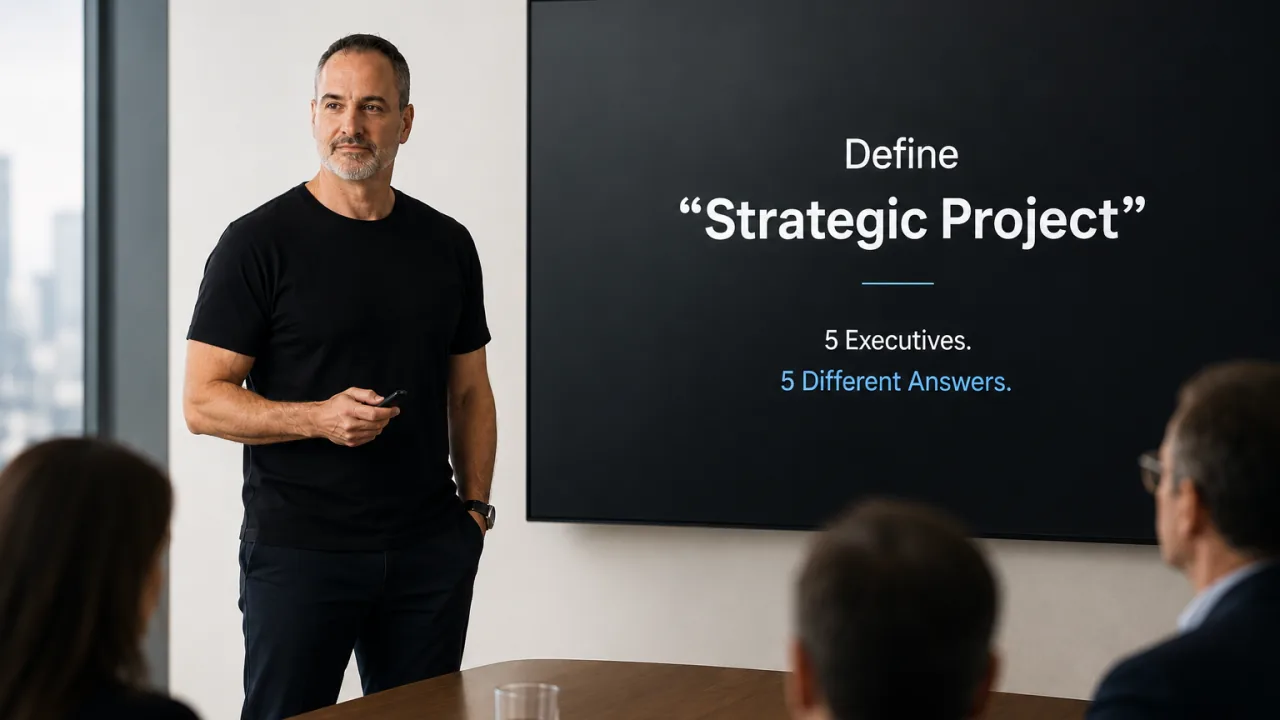
The more I work with artificial intelligence, the more convinced I become that its biggest impact isn’t in what it can do for us, but in what it forces us to see about ourselves.
I recently sat down for coffee with a friend who runs a technology company. During our conversation, he asked me: “What do you think will be AI’s biggest impact on organizations?”
I assume he expected me to talk about automation, time savings, productivity, or maybe even workforce replacement.
But I found myself saying something completely different: “I think AI’s biggest impact will be exposing how little we actually know how to explain about our own organization.” He looked at me a bit surprised, so I tried to explain with an example.
A small example that illustrates the point
Suppose an organization invested in an AI system meant to help leadership make strategic decisions. The system is connected to almost everything in the organization: work plans, financial reports, sales data, CRM, market research, board presentations and policy documents. On paper, it has everything it needs to give a good answer.
Then, in a leadership meeting, the CEO asks a very practical question: “If we need to cut 20% of our investments this year, which strategic projects can we not afford to stop, and which can we let go?”
The system pauses for a moment, then asks: “Before I can answer, please define what a ‘strategic project’ means for your organization.”
And this, in my view, is where the interesting moment begins.
- The VP of Development: “Any project that develops new technology.”
- The VP of Sales: “Any project that brings in a strategic customer.”
- The CFO: “Any project that generates high returns.”
- The VP of Operations: “Any project that increases production capacity.”
- The CEO, listening to everyone: “It’s probably a combination of all of that.”
The AI didn’t get stuck because it lacked data. It got stuck because it lacked a definition.
Here, I believe, is the real insight
In a moment like this, you realize the challenge isn’t necessarily technological. Often it’s managerial, organizational and even cultural.
I’ve seen quite a few organizations that make very good decisions over the years, but much of that ability lives in the heads of experienced people. It works until you try to translate it into a shared language, into clear rules, or into a system that needs to understand the logic behind the decision.
We constantly use terms like “strategic project,” “strategic customer,” “innovation,” “high priority” or “critical.” But when you ask five managers to define the same concept, you often discover five different interpretations. All reasonable, but not necessarily identical.
A similar example from the world of customers
An organization asks an AI system to recommend which customers should receive senior management’s attention next quarter.
- For sales, a strategic customer is one with high revenue potential.
- For service, it is a customer with high complexity and a risk of churn.
- For R&D, it is a customer that drives important product requirements.
- And for finance, it may be a profitable, stable customer that pays on time.
If the organization has not defined what truly makes a customer “strategic,” the AI may produce a recommendation that looks precise, but in fact rests on only one of several possible interpretations.
Intuition works great, until it needs to become a method
I strongly believe in managerial intuition. In experienced managers, it isn’t a random gut feeling, but the result of years of experience, successes, mistakes and deep familiarity with reality. But it has one significant limitation: it’s very hard to pass along as-is.
As long as everyone sits in the same room and knows the same people, customers and problems, this usually works. But when the organization grows, splits across sites, becomes global, brings on new employees or implements an AI system, you can no longer rely solely on unwritten understanding. An AI system doesn’t know how to “feel” what you meant. It needs clarity, definitions and consistency.
Not just data quality, definition quality too
For years we talked, rightly, about data quality. But in the AI era that’s no longer enough. We also need to talk about the quality of our definitions. If the same concept means something different to every manager, even the most advanced system will struggle to know which meaning to act on.
And there is a real risk here. Implementing AI on top of existing ambiguity doesn’t necessarily fix the problem; sometimes it simply accelerates it. Unclear decisions are made faster, unresolved interpretations gain the authority of “the system,” and confusion that used to be slow and human can become automated, consistent and more convincing.
What AI really surfaces in an organization
Working with organizations, this is one of the things that surfaces very quickly:
- One process that turns out to be three different processes.
- A decision made based on one person’s experience rather than an agreed-upon principle.
- Critical knowledge that was never documented.
- Different departments using the same word but meaning different things.
AI didn’t create these things. They were already there. AI just put a spotlight on them.
First and foremost, a management revolution
Organizations that use AI only to work faster will probably gain quite a bit. But organizations that also use it to examine themselves, their language, their assumptions and the way they make decisions, will be able to build a deeper, more meaningful advantage.
In my view, one of the first steps an organization should take before rushing to implement another AI tool is to build a basic organizational dictionary: what is a strategic project, what is a key customer, what is high priority, what counts as material risk, and what is success. This might sound simple, almost trivial, but in practice it’s one of the most important foundations for working with artificial intelligence. The clearer the organizational language, the more precisely AI can help.
I’m not sure we’ll measure organizations in the future only by which AI model they chose or which tools they implemented. Maybe we’ll ask a simpler question: does the organization know how to explain to itself how it makes decisions?
If the answer is no, then the big challenge probably isn’t artificial intelligence; it’s organizational intelligence. Only after we understand ourselves better will we truly be able to extract the value AI can deliver.
Try this at your next leadership meeting
Ask each manager to write, without consulting the others, a short definition of a term you use all the time: “strategic project,” “key customer” or “top priority.” I suspect the results will spark a very interesting conversation.
AI and organizational readiness is part of our Executive Advisory practice.
This article reflects the author’s personal opinion only. It is general information, not professional advice or a recommendation to take any action, and any use of it is the reader’s sole responsibility.