
Insight · Leadership and management
Great Engineers Don’t Always Become Great Managers
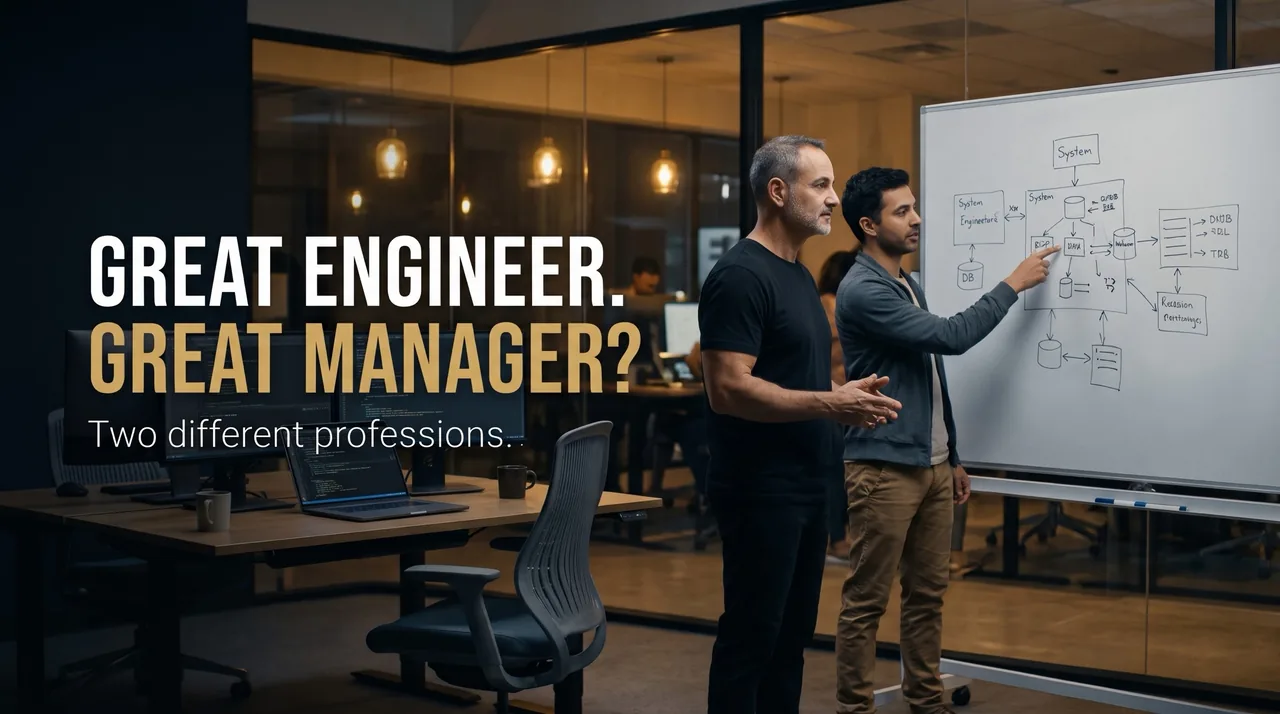
Engineers who have worked with me in the past, and some who work with me today, often reach out to me with the same question: "Eyal, what role do you think I’m right for next? Maybe it’s time I moved up and became a manager?" Those conversations are what led me to write this article, because the answer is far more complex than it seems.
One of the most common mistakes in technology companies is made with the best of intentions: promoting the best engineer on the team into management, and assuming the success will carry over. Sometimes it does. But in many cases, the organization discovers that in a single move it lost its best engineer and did not gain a manager.
I see this transition from both sides of the table. Over my career I have interviewed and met hundreds of engineers in Israel, the United States, India, Japan and Europe, and heard how they imagine management before they get there. At the same time, as a mentor in an Executive MBA program, I have worked with students who came from senior management roles, and heard what they wish they had known.
The gap between these two pictures is what this article is about, and it can be illustrated with a story that anyone who has worked in a technology organization will recognize.
Three months after the promotion
Let’s call her Maya. As an engineer, she was the one everyone turned to when something got stuck. She could solve problems others couldn’t crack, and she loved it.
Now, after the promotion, Maya works longer hours than ever. She still solves the hard problems herself, because "it’s faster this way." The team waits for her approval on every decision, and the project is slipping precisely because of her. When someone on the team proposes a solution, she immediately sees what she would do differently, and doesn’t always manage to hold back.
At the end of each day she feels she accomplished nothing, because she didn’t write a single line of code. And her manager, who promoted her because she was technically excellent, can’t understand what went wrong.
It isn’t a question of talent
Maya doesn’t lack talent. The problem is that she keeps measuring herself by the rules of her previous role. As an engineer, her success was measured by what she created herself. As a manager, it is measured by what her team creates, even when she didn’t touch it.
Moving into management requires a change in professional identity. A good engineer is used to knowing the answers, while a good manager learns to ask the questions and let others find the answers themselves, even when it takes them longer.
As an engineer, your success is measured by what you produce yourself. As a manager, it is measured by the throughput of the whole system.
To make this transition, a new manager has to give up the need to be the smartest person in the room. Maimonides put it more than eight hundred years ago, in a line I come back to often: "Hear the truth from whoever speaks it." A manager who understands that the job is to make sure the right solution is chosen, even when it comes from the most junior person on the team, allows the whole team to move forward.
I have seen this pattern many times, in development teams and on factory floors, in small companies and large ones. Letting go of what you do best is almost always the hardest part of the transition.
What engineers say in interviews
When I ask engineers in an interview where they see themselves in five years, the most common answer is "team lead." And when you ask why, most answers describe management as a bigger version of engineering work: deciding on the architecture and being the one who knows the answer. Almost no one talks about people.
That holds everywhere I have hired, but what it looks like differs a great deal between engineering cultures. These are patterns I have encountered again and again, not a rule that applies to every person.
India. In engineers from India I have met a genuine hunger to grow, and a very high commitment to career and team. The ambition to manage often comes early, because in many organizations there, it is the accepted way to show progress. That is excellent energy, and what worked for me was channeling it well: showing that there is also a senior technical track with real recognition, and describing honestly what management actually demands.
United States. In the US I have met professional confidence and a culture that values expertise. The technical track is well established, and roles such as Staff Engineer and Principal Engineer are highly respected. Many engineers choose to remain experts and have impact without managing, and don’t see it as a compromise. It is a model many organizations, including in Israel, can learn from.
Europe. In Europe, and especially in Germany, I have met exceptional professional depth and thoroughness. Expertise is highly valued, and managers are expected to be experts in their field too. That gives managers real authority with their teams, so their challenge is knowing when to let go of the technical side, to allow others to grow.
Japan. In engineers from Japan I have met an exceptional commitment to quality and continuous improvement, and real pride in the craft of engineering itself. Promotion to management often rests on experience and seniority, and the manager is seen first as the one responsible for consensus and harmony in the team. It is an approach that prepares managers with patience and depth, and from it I learned that a good manager doesn’t have to be the loudest voice in the room. It is enough to make sure everyone is heard.
Each of these cultures taught me something I took with me. And yet one thing repeats everywhere: engineers imagine management as a continuation of technical work, and discover it is a different profession.
A small tip for anyone hiring
Instead of asking an engineer whether they want to manage, I ask them to tell me about a time they helped someone else on the team succeed, even at the expense of their own time. Those who answer immediately, with a specific example, are probably already managing without the title. Those who struggle to find one are probably not there yet.
What senior managers say in hindsight
In the Executive MBA program I mentored students who had already led large teams and entire divisions. When we talked about what they wish they had known at the start, almost no one mentioned technology or strategy. They talked about the first difficult conversation with an employee, and about how long it took them to stop solving everything themselves. These are exactly the things no one teaches along the way.
What no one teaches along the way
Engineers spend years training to be good at their profession. New managers usually get a congratulations and a team, and start working. Here are some things almost no one explains to them in advance:
- Delegate without abandoning. Hand over a task and stay available, without taking it back the moment it doesn’t move the way you would have done it.
- Difficult conversations. Telling an employee their performance isn’t enough, or telling a long-time friend on the team that they didn’t get the promotion. These are the conversations new managers tend to postpone, and the ones most important to have on time.
- Pay the price of learning. Accept that the team will make mistakes, and back it up with senior management while it learns. Without that, the team will keep waiting for your decisions.
- Say "no." Suddenly everyone wants something from you, and not every request matters equally. A manager who agrees to every request struggles to deliver on the ones that matter.
- Manage up. Explain to leadership what the team needs, and raise problems early. Engineers are used to the work speaking for itself, while a manager also needs to present it.
- Your calendar changes. Much of the day goes to conversations and meetings. This is a central part of the management role.
What organizations can do differently
The most common mistake is assuming that promotion to management is the only way to recognize excellence. When it is the only path, the organization pushes its best engineers into a role they don’t necessarily want, and sometimes aren’t suited for.
Good organizations build two parallel career paths, one managerial and one technical, with the same recognition and the same pay. An excellent engineer can become a senior expert and influence the entire organization without managing anyone.
And those who choose management need real support in their first months, not just a two-day course. An experienced mentor and regular conversations with their direct manager help a great deal during this period.
For the new manager
If you’ve just been promoted, here are a few things I wish someone had told me at the start:
- Change how you measure a good day. A good day is one where someone on your team solved a hard problem thanks to you.
- Ask before you answer. "What would you do?" is one of the most powerful questions a manager can ask. It teaches the team, and tells you things you didn’t know. Albert Einstein once said, "The important thing is not to stop questioning." The same holds in management.
- Accept that it takes time. No one is born a manager. Confidence in the role comes after months, not weeks.
- Find someone to talk to. A mentor or an experienced manager who has been through it. Most dilemmas you will face, someone has already met before you.
And Maya?
In stories like Maya’s, the turning point almost always comes from the same place: a mentor who walked the path before her, who asks one simple question: "What would have happened to your team if you hadn’t solved that problem yourself?" From that moment, she stops measuring her own output and starts building her team’s.
A great engineer can certainly become a great manager. But it doesn’t happen by itself, and it doesn’t happen on the day of the promotion. After hundreds of interviews and conversations, and years of mentoring managers, I’m convinced it happens when the engineer understands that the new role requires letting go of what made them excellent in the first place, and when the organization gives them the time and support to learn it. And to everyone who comes to me asking "Maybe I should become a manager?", my answer almost always starts with another question: what do you love most about your work today, and are you willing to give up some of it?
Executive mentoring and leadership development are part of our Executive Advisory practice.
This article reflects the author’s personal opinion only. It is general information, not professional advice or a recommendation to take any action, and any use of it is the reader’s sole responsibility.